Ingredient Library - Retinoids
Retinoids in Skincare: Benefits, Types, and How to Use Them
Retinol, retinal, tretinoin: these similar names can make choosing skincare surprisingly confusing for many. They belong to the retinoid family, but they differ in how they work, how they are formulated, and what the research supports.
Understanding those differences helps you choose a product for your skin rather than simply chasing the highest percentage. Here is what to know about retinoids, their potential benefits, and building a skincare routine you can use consistently. Day by day.

What are retinoids?
Retinoids are vitamin A-related compounds used in cosmetic skincare and medicines. Some target visible aging; others are established acne treatments. The family includes retinol, retinaldehyde, tretinoin, and synthetic medicines such as adapalene. Oral isotretinoin is also a retinoid, but it requires medical supervision and is outside this article’s everyday skincare focus.
Retinol is one type of retinoid. Comparing “retinol versus retinoids” therefore compares an individual ingredient with the family it belongs to.
Retinol, retinal, and prescription retinoids compared
| Ingredient | Where it fits | Important distinction |
|---|---|---|
| Retinol | Common cosmetic vitamin A ingredient | Requires conversion in skin before producing retinoic-acid-mediated effects |
| Retinal, or retinaldehyde | Cosmetic retinoid studied for visible aging | One conversion step from retinoic acid |
| Tretinoin | Prescription topical retinoid | Retinoic acid itself |
| Adapalene | Acne medicine; some strengths available without prescription in the US | A synthetic retinoid with its own evidence and directions |
| Tazarotene and trifarotene | Prescription topical retinoids | Medical treatments selected for specific indications |
The simplified pathway is retinol → retinal → retinoic acid. Experimental research supports this conversion process, although skin also stores and metabolizes vitamin A through other pathways.
Read also: Retinol vs retinal - what is better to your skin
Fewer conversion steps do not establish that a serum works a fixed number of times faster. Concentration, delivery, stability, and the complete formula all affect performance. Percentages of different retinoids are not interchangeable.

What benefits can retinoids offer?
Fine lines and visible skin aging
Retinoids can influence skin renewal and collagen-related processes. However, results demonstrated for one molecule or medicine should not automatically become claims for every cosmetic serum. In a randomized, vehicle-controlled study, researchers applied 0.4% retinol to the arms of older adults for up to 24 weeks. They reported improvement in fine wrinkling and increases in selected skin markers, including procollagen in a small biopsy subgroup.
This supports retinol’s biological and cosmetic potential. It does not establish identical results on younger facial skin or with a different concentration and formulation.
Texture and uneven-looking tone
Retinol is used to improve the appearance of rough texture and uneven pigmentation. [1] These changes are gradual. A serum cannot erase every dark spot, remove deep folds, or reproduce a lifting procedure.
Acne and clogged pores
Certain topical retinoid medicines help prevent pore blockage and treat acne. Adapalene and tretinoin are examples. [1] A cosmetic retinal or retinol serum should not be assumed to provide the same acne-treatment results as an approved medicine.
Persistent acne, painful lesions, or scarring deserve a treatment plan with a dermatologist.
Why retinal deserves attention
Retinaldehyde occupies an interesting position between retinol and retinoic acid. Researchers have investigated whether it can improve visible aging while remaining tolerable in a suitable formula.
A 2021 split-face study enrolled 23 Korean volunteers. Participants used a multilamellar-vesicle retinaldehyde cream on one side of the face and a retinol cream on the other for eight weeks. Both sides improved in measured outcomes; the retinal formulation performed better on several assessments, including wrinkle-related measures.

The study was small, short, and tested particular formulations. Its findings do not prove that every retinal product outperforms every retinol product. They also cannot substantiate claims such as “works ten times faster” for an unrelated serum.
How to introduce a retinoid to your skin
Follow your product’s directions or your prescriber’s instructions. For cosmetic products, gradual introduction and moisturizer can help limit irritation. A simple evening routine might include:
- A gentle cleanser.
- Your retinoid, applied as directed.
- A moisturizer suited to your skin.
Start with a low frequency, such as every other evening or less often if needed, and increase only as tolerated. More frequent use is not automatically better. Avoid introducing several intensive treatments simultaneously; doing so makes it harder to identify what causes discomfort. Use daytime sun protection consistently. Choose broad-spectrum SPF 30 or higher, reapply according to the label, and include shade and protective clothing.
Irritation is not proof that a product is working
Dryness, redness, and irritation can occur, particularly during introduction. Skin with rosacea, eczema, or significant sensitivity may need individual advice before starting. Irritation can also leave dark marks, especially in darker skin tones.
Reduce frequency or pause if your skin becomes uncomfortable. Persistent burning, swelling, or a worsening rash warrants stopping the product and seeking advice. Do not automatically label every new breakout “purging.” Worsening skin can reflect irritation, an unsuitable formula, or a condition requiring treatment.
Read also: Can retinal serum help with skin disorders
Pregnancy and breastfeeding
Avoid retinoids during pregnancy, including cosmetic retinol and retinal. If you are trying to conceive, discuss your routine with your clinician. Ask for product-specific guidance during breastfeeding rather than assuming all topical products have the same recommendations.

Frequently asked questions
Is retinal the same as retinol?
No. They are related vitamin A compounds with different chemical structures. Retinol is converted to retinal before retinoic acid can be formed.
Is a higher percentage better?
Not necessarily. A number does not describe the entire formulation or predict your tolerance. A percentage of an ingredient blend may also differ from the percentage of active retinoid. Ask the manufacturer what the stated figure represents.
How long should I wait for results?
Think in weeks to months. The clinical studies discussed here assessed outcomes over eight and 24 weeks. Those are study durations, not guaranteed timelines for another product.
Should I use two retinoids together?
There is usually little practical reason to add a second retinoid to a routine without professional guidance. Keep the routine manageable and follow the directions for your chosen treatment.
The BioMaxx Skin Lab perspective
Retinoids reward informed choices and realistic expectations. Choose according to your concern, the evidence for the ingredient and formula, and how comfortably the product fits your routine.
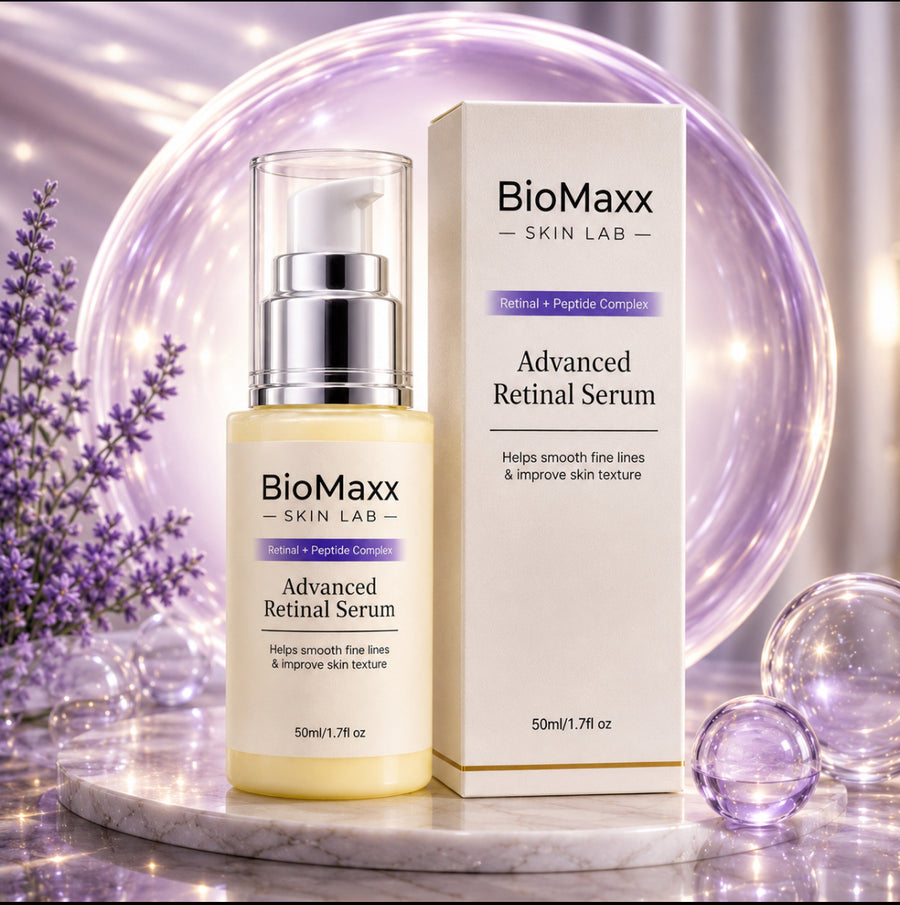
When considering BioMaxx Skin Lab Advanced Retinal Serum with Ginseng, follow its current label and directions. Research on retinal explains the ingredient’s potential; it does not establish that the finished serum has reproduced the clinical outcomes described above.
Educational information; not a substitute for individualized medical advice.
References
American Academy of Dermatology. Retinoid or retinol?
Biological activity of all-trans retinol requires metabolic conversion to all-trans retinoic acid. J Biol Chem. 1994.
Metabolism of topical retinaldehyde. Dermatology. 1999.
Kafi R, et al. Improvement of naturally aged skin with vitamin A (retinol). Arch Dermatol. 2007.
Kim J, et al. The efficacy and safety of multilamellar vesicle containing retinaldehyde. J Cosmet Dermatol. 2021.
American Academy of Dermatology. Dermatologist-approved pregnancy skin care.